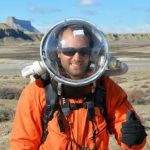

Jon lives in Canberra, Australia’s bush capital, and is a general practitioner in geology. He started out life as a palaeontologist, doing honours in Silurian palaeoecology at the University of Tasmania. He then became an exploration geologist in South Australia, looking for Permian coal and Cambrian oil and sodium carbonate salts. That was followed by a Ph.D. at Flinders University in Adelaide on the deposition and diagenesis of Cambrian limestones, including fossil sponge-microbe reefs. After six months in marine surveys of the Great Australian Bight for the federal government, he joined a resource company and spent the next decade in exploration. This included looking for gold and nickel near Kamblada Western Australia, copper, gold, and zinc exploration in Queensland and South Australia, copper and gold exploration in the Philippines, Chile and South Australia, and gold in Victoria. He then taught geology at the Australian National University for several years before joining the federal government at Geoscience Australia working in salinity management in Queensland, Victoria, South Australia, and NSW, groundwater exploration in NSW, and precompetitive mineral exploration in Victoria, as well as taking part in a review of rare earth, lithium, and potash potential in Australian salt lakes.
Jon has been interested in Mars since he was about ten years old, before people even walked on the Moon. Since finding out about Mars Society Australia in 2001, he has taken part in six expeditions to inland Australia, one to New Zealand, one to India, and three MDRS rotations. His Martian interests include Martian geology and geomorphology and their terrestrial analogues, astrobiology, exploration technologies (especially habitats, vehicles, and suits), mission architectures, and human factors. He currently serves as president of MSA, is on the Mars Society International Steering Committee, and is director of science at MDRS.
In the rest of his life he is married to Anna, a community maternal and child health nurse, has two grown up and married daughters, one has an MA in museums and collections and works in a local heritage library, the other is earning a Ph.D. in cancer research. They have a cat and an elderly guinea pig for company. He likes watching and reading SF, history, and the interaction of science and theology. Jon also scuba dives, hikes, and camps when he can, and is a volunteer in the local rural fire brigade.